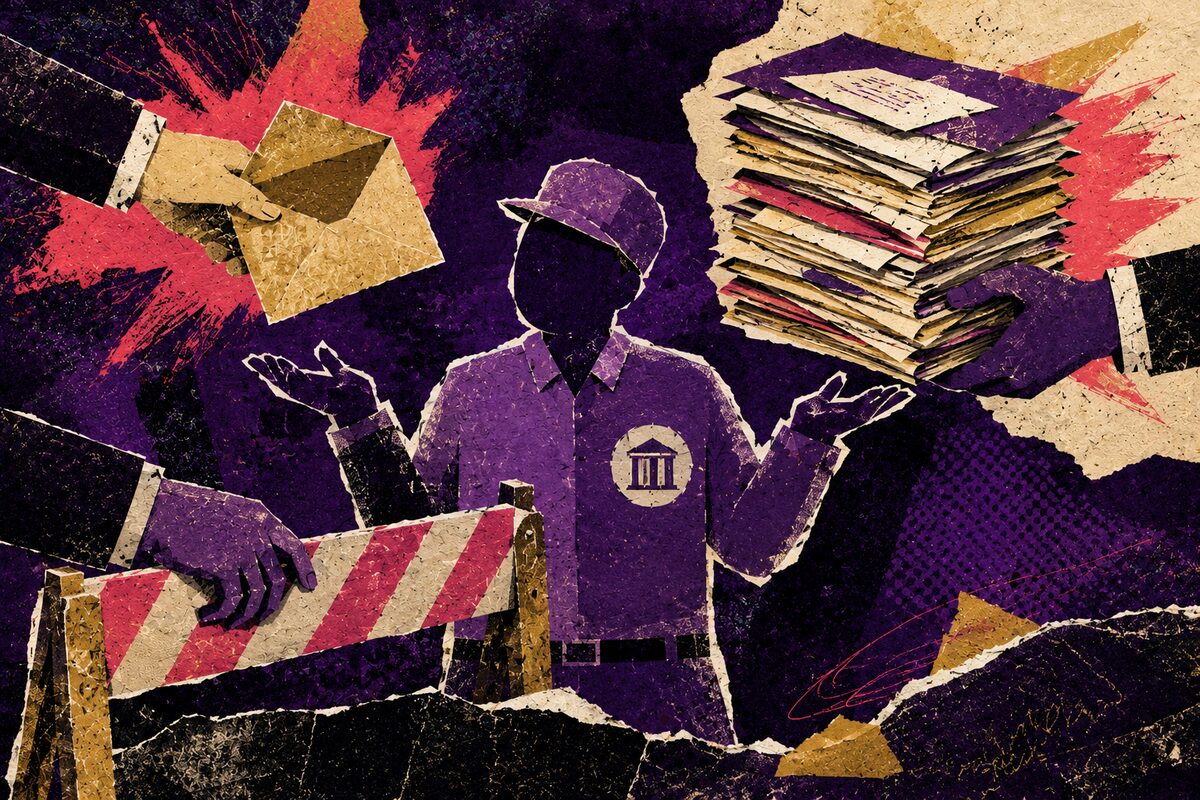
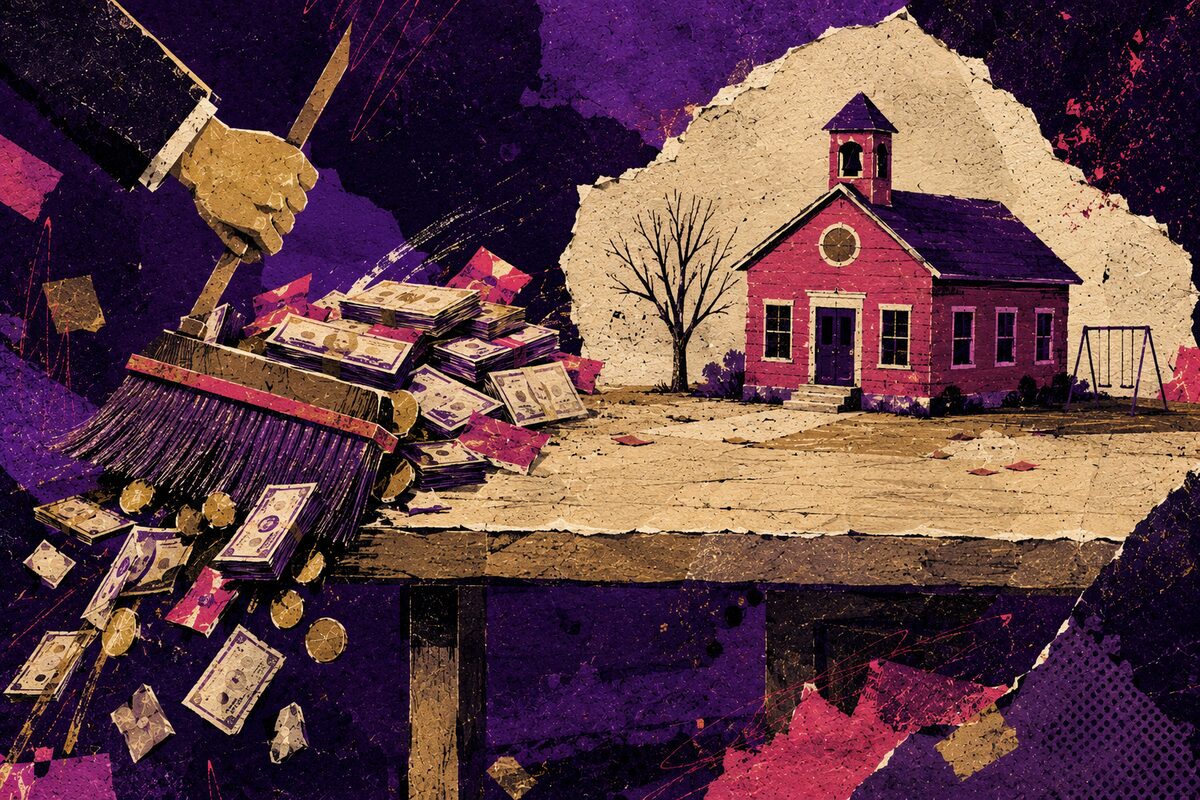
None of this is waste. It's the stuff you actually use: your kid's school, the ambulance, the deputy down the road. The county spending the money was never the problem. The trouble starts with where that money has to come from.
02
02 · the catch
It can't really say no.
02It can't really say no.
Almost everything the county spends on, the state makes it do. Tap any of these to see who gives the order, and who's stuck paying for it.
Public schoolsState-requiredtap +
Who orders itThe state constitution. Every county has to fund schools.
Who paysThe state covers a base, then the county piles local property-tax money on top.
The catchSchools can't tax anyone themselves. They get whatever the county hands them.
ElectionsState-requiredtap +
Who orders itState law, run exactly the way the legislature says to run it.
Who paysThe county. New machines or new ID rules just become a local bill.
The catchNobody ever votes to "fund elections." It just shows up in the budget.
Sheriff & jailState-requiredtap +
Who orders itThe state. A sheriff and a county jail aren't optional.
Who paysThe county, just about all of it.
The catchThe building, the staffing, the state standards: those costs are mostly fixed. Split among 20,000 people instead of 200,000, the same jail costs far more per person.
Social servicesState-requiredtap +
Who orders itThe state and the feds. Medicaid, food aid, child welfare.
Who paysMostly state and federal money, but the county hires the people and rents the building.
The catchThe program money comes from above. The staff and space are local.
CourtsState-requiredtap +
Who orders itThe state runs the courts. The county provides the courthouse.
Who paysThe county builds it, heats it, secures it, and keeps it standing.
The catchIt's a split bill that nobody really sees.
Public healthState-requiredtap +
Who orders itState law. Every county has to provide public health services: restaurant inspections, disease control, immunizations.
Who paysState and federal grants cover pieces. The county funds the department and covers every gap.
The catchThe standards come from Raleigh. The staffing, the building, and the shortfall are local.
So the state decides what has to get done, and your property tax is what pays for it. Add it up, and mandated work is well over half of what a county spends.
That "well over half" is the UNC School of Government, the standard reference on how NC counties work.
03
03 · zoom out
That was your $1,000.
Now back up and look at the whole county. It's your thousand plus everybody else's, plus a slice that comes down from the state and the feds.
Sourced · Forsyth FY2026-27 budget
Who funds the county≈ $601M / yr
Property tax · 61%The county's main source, and the only one it really sets itself. This is the number that goes up or down.You set this
Sales tax · 18%The county keeps a small slice of what people spend. It can't make anyone spend more, and the state caps how much it's allowed to charge. Any increase needs a public vote.Limited
State & federal · 8%Money sent down from Raleigh and Washington, mostly locked to specific programs like Medicaid and social services. The county can't move it around.Locked
Other · 13%Fees and permits, what the county earns on money it holds, and savings it draws down. Real money, but small pieces, and a lot of it one-time.Limited
Property tax is the only one the county really controls. And look at that small gray slice: the state orders up most of this budget, while its check covers a sliver. Keep going, because the property-tax piece ends up doing all the work.
04 · the squeeze
It keeps piling up.
04It keeps piling up.
Here's how it works. The state writes the county's to-do list. And it keeps making that list longer and more expensive, without sending money to match. Three receipts:
Pensions · sourced — NC Treasurer
The state board nearly doubled the rate.
Counties pay into the state-run pension system at whatever rate a board in Raleigh sets. Commissioners don't get a vote; they get an invoice. Forsyth's own budget names these mandated contributions as a top cost driver.
7.75% of payroll · 2018
14.35% now · deputies 16.1%
School buildings · sourced — DPI needs survey
$12.8 billion of school construction
What NC districts said they need over five years to build and fix schools. Buildings are the county's bill, not the state's. The state pitched in about $838 million over a similar stretch, mostly lottery money. The rest is local debt: about 70% of what Forsyth owes was borrowed for schools.
That split goes back to the Depression. Counties couldn't keep the schools open, so in 1931 and 1933 the state took the schools over, paid for it with a brand new sales tax, and left the buildings to the counties. It's still the law today.
And for sixty years the state helped with the buildings anyway. Voters passed statewide school construction bonds in 1949, 1953, 1963, 1973, 1986, and 1996. There hasn't been one since. Then in 2013, the tax overhaul that started the corporate rate on its way to zero also repealed the corporate income tax earmark that had been paying for school construction since 1987. Same bill. One section cut the rate, another killed the earmark.
Buildings were always the county's job under that deal. What changed is that the state used to help anyway, and now it doesn't. As for the half Raleigh did take on, the money to actually run the schools, that one spent thirty years in court. It's called Leandro.
Bond years, the 1987 fund, and the 2013 repeal: NC Association of County Commissioners. The 1931-33 School Machinery Act: NCpedia. Buildings as the county's job: G.S. 115C-408(b). The 2013 bill is S.L. 2013-316, sections 2.1 and 2.4.
New costs, rolling downhill
$69 million a year, just added
The new SNAP administration bill just shifted onto NC counties. Add new election requirements and State Health Plan premium hikes. All of it lands on the county's books.
New-cost figures: NC Budget & Tax Center (an advocacy group), April 2026. Pension rates: NC Treasurer. School needs: NC DPI facility needs survey.
And the list keeps going
The state orders counties to exempt 80% of solar equipment value from property tax. Counties eat the lost revenue.
State standards for medical and mental health care in county jails. County checkbook.
New election rules and deadlines, sent down without a dollar attached.
State Health Plan premium hikes, billed to the counties enrolled in it.
Hurricane Helene recovery costs, fronted by counties while reimbursements crawl.
The counties' own bipartisan association keeps the running list. Its legislative goals ask the state, over and over, to stop mandating without funding. Last two items: NC Budget & Tax Center, April 2026.
None of that ever shows up as a state tax. It shows up as your county "raising your property taxes."
05
05 · and then
Then it gets harder.
Zoom out, and it's three state moves happening at once.
It cut its own income
The state keeps cutting its own taxes, with the corporate rate headed all the way to zero. A state that collects less has less to send down, and less appetite for picking up the list it writes. The next chapter puts a number on it.
It made the list pricier
Pension rates nearly doubled. New SNAP costs. New election rules. School buildings still on the county. You just saw the receipts.
And now it wants to cap the county's one tool
When the county covers the gap the only way it can, through property tax, the legislature moves to cap that too. It passed a bill putting a constitutional amendment on your November ballot.
Less money coming in, more orders going out, and a cap on the way for the one tool counties have left.
Same move, different decade
1980sThe state repeals local tax bases and promises to reimburse counties for the loss.
2001In its own budget crunch, the state keeps those reimbursements for good, about $333 million a year, and lets counties levy a sales tax instead.
2026Now it's moving to cap the counties' main tax in the constitution.
The 2001 repeal and the $333 million: NC General Assembly fiscal records for the 2001 budget act.
06 · the choice
The money is there.
06The money is there.
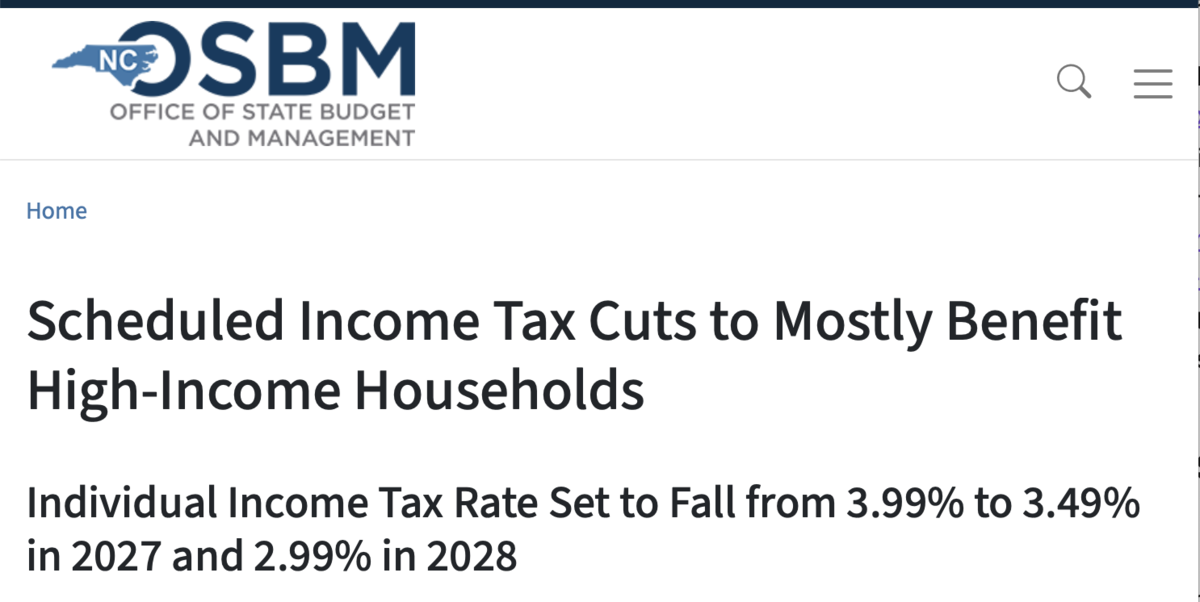
Here's the part that gets me. This isn't a law of nature, it's a choice. The state is handing out income tax cuts, and its own budget office laid out who they're really for.
Sourced · NC Office of State Budget & ManagementREAL — NC OSBM, on the state's scheduled income tax cuts
Who actually gets the cut? The state's own math: the top 5% of earners take more than 40% of it. The bottom 40% of households split just 3.3%. The richest 1% average over $8,000 back, while nearly four in ten households get under a hundred bucks.
And sure, the biggest earners pay the most income tax, so any rate cut tilts their way. That's kind of the point. Of all the ways the state could hand money back, it keeps choosing the one that works like that.
Add it all up, and here's what the state is choosing to give away.
$9.7B
a year by the mid-2030s, the revenue the state is forgoing to these tax cuts, with the largest share flowing to corporations and the highest earners.
Source: NC Office of State Budget & Management (nonpartisan), read it yourself. The $9.7 billion is OSBM's figure for all the cuts scheduled under current law, individual and corporate combined, by FY 2033-34. The who-gets-what figures are OSBM's estimates for the first scheduled rate cut, 3.99% to 3.49%, among households that file.
The corporate rate is the clearest tell. It was 6.9% in 2013, and it hits zero in 2030. That piece alone is about $1.8 billion a year.
77%of North Carolina voters said they're against zeroing out the corporate tax, so this isn't really a partisan thing.2024 TargetSmart poll, via NC Budget & Tax Center (an advocacy group).
Here's where it lands on you. Every dollar the state stops collecting up top is a dollar it doesn't send back down. But the bills it mandates keep coming, and the county has one real lever left to cover them: the property tax you met at the start.
07
07 · out in the county
It's harder in rural places.
07It's harder in rural places.
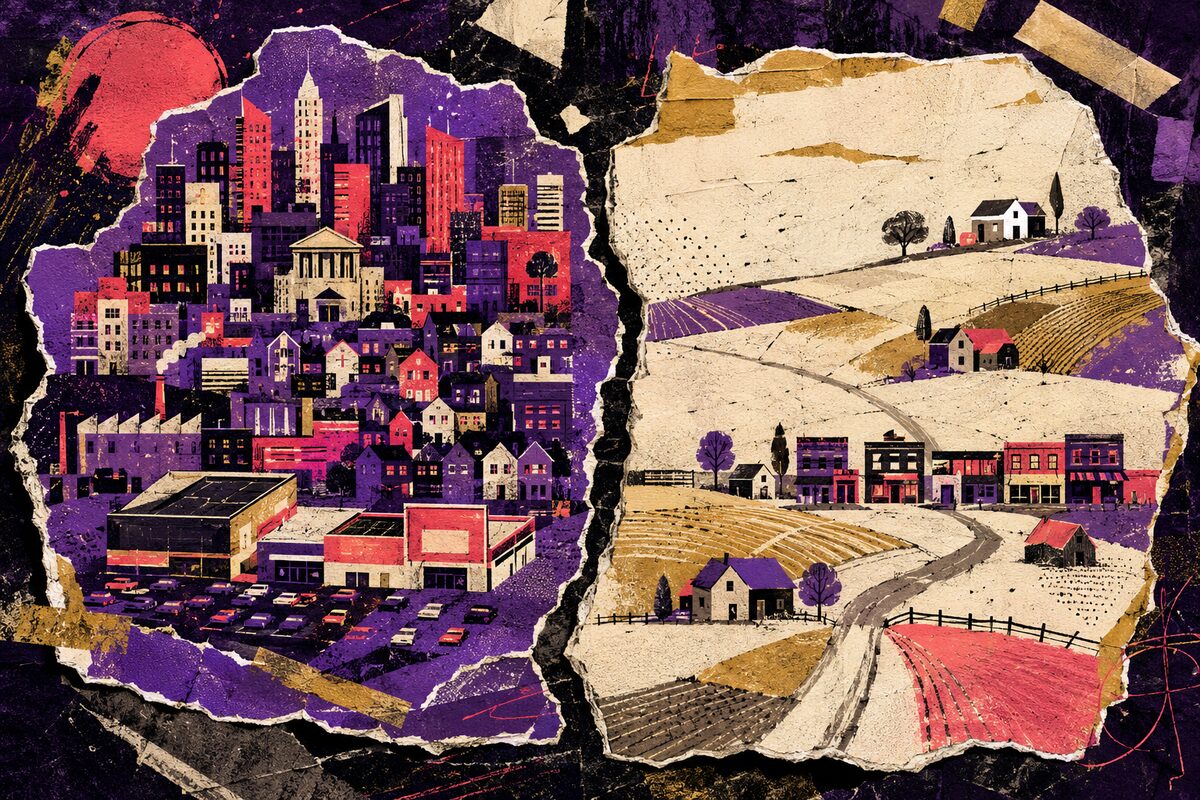
You're looking at the county with the bigger tax base. Now look next door. Stokes is mostly homes, farms, and small towns, so the same orders from Raleigh land on far less to tax.
Here's what that does. The rural county taxes itself harder and still raises less:
53.52¢
Forsyth rate
62.5¢
Stokes rate, higher
It plays out statewide. Wealthier counties end up with far more to spend, even though rural counties tax themselves harder. Wake and Greene run the same pattern:
51.71¢
Wake rate
78.60¢
Greene rate, higher
Greene taxes itself about half again as hard as Wake. Here's what each one's schools manage to add to teacher pay:
$9,828
Wake County supplement
$1,000
Greene County supplement
Teacher supplements: Public School Forum of NC, 2023-24. Local supplements only: the state adds up to $4,250 in low-wealth counties through a separate allotment. The gap shown is the local piece. Rates: NCDOR / county budgets, FY2025-26.
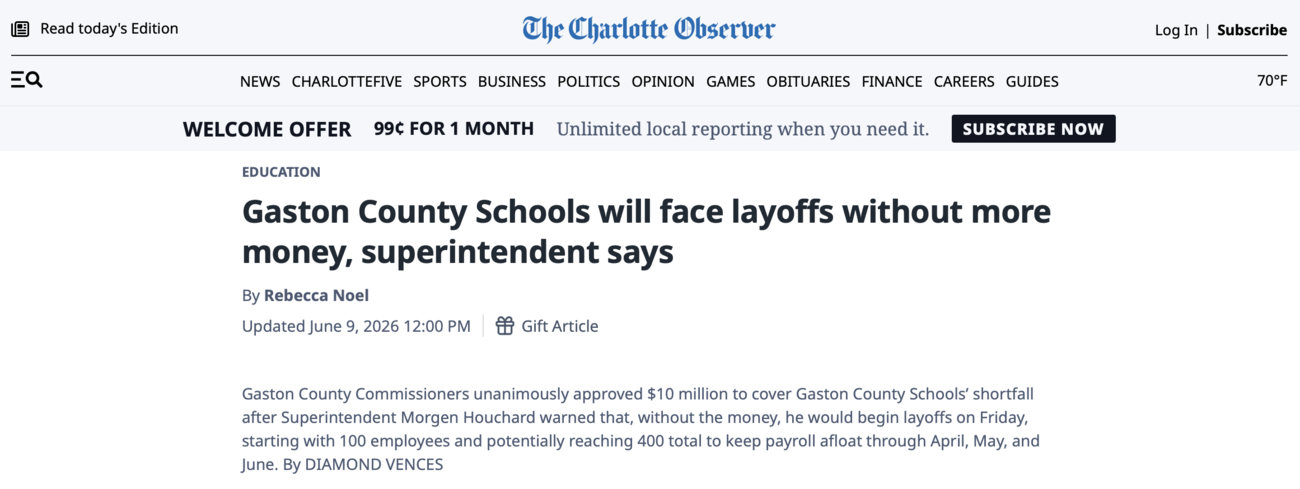
When the money runs short, the county is the last line of defense. Gaston County Schools warned it would cut up to 400 jobs over a budget shortfall. County commissioners put in $10 million, the district still shed staff, and by June it was warning of layoffs again. That's the backstop you pay for, and in a county the money comes mostly from local property tax.
08
08 · the other side
Plenty of people feel gouged.
And they're not wrong to. A cap sounds like relief. Here's the case for it, and the catch.
The case for the cap
A March 2026 Carolina Journal poll found 76.8% call property taxes a burden and 73.2% back the amendment. Speaker Destin Hall and the John Locke Foundation argue local governments overtax: they point to the 10 largest counties collecting about $2.6 billion more than a strict limit would have allowed.
Poll + figures: Carolina Journal / John Locke Foundation (pro-cap).
The catch
The cap treats the symptom. Rep. Deb Butler of New Hanover put numbers on it during the House debate: a levy limit might save a typical household around $300, while fixing the property tax relief programs the state already has could save some homeowners up to $6,000. And the driver doesn't move: cap the county's only real lever and you don't lower the bills the state mandates. You just force cuts to libraries, EMS, and schools.
House debate + relief comparison: NC Newsline, May 2026.
09
09 · your ballot
Just do the job.
09Just do the job.
REAL — Carolina Journal, May 2026 · HB 1089 / Session Law 2026-5
This November, the amendment on your ballot orders a cap on how much your county's property tax can grow. The catch: it doesn't set the limit. It tells the legislature to write one later. You'd be voting yes on a cap before anyone says how tight it is.
On your Nov 3, 2026 ballot:
"Constitutional amendment requiring limits on property tax increases by local governments."
HB 1089 · Session Law 2026-5
The state has the money. It's choosing tax cuts and leaving your county to cover what's left. Capping the county doesn't change any of that. The legislature just has to do its job.
So what can you actually do about it?
Ask Them
The rate on your bill is set by your county commissioners. The squeeze that pushed it up was written in Raleigh. Your legislators can tell you which votes they cast, and they have to answer if you ask.
Every county's rate is public, all 100 of them on one page. Worth a look before the next budget season, especially if yours went up while the state's income tax went down.
 ← back to the guides
Español
← back to the guides
Español