A Field Guide to Your Power Bill

Why is my power bill so damn high?

I used to blame fuel prices too. The truth is stranger: Duke doesn't really make its money selling you electricity... it makes money building things, and your bill is the payment plan.

the short version · tap anything

Two more increases are already scheduled, and the reason is simple: Duke gets paid to build. Here's the whole story, piece by piece.

What you're actually paying for

Start with what's already happened, because you've been feeling it. In its 2023 rate case, Duke Energy Carolinas won three increases in a row: a typical household bill went up $10.04 a month in January 2024, another $4.19 in January 2025, and another $4.10 this past January, taking a 1,000 kilowatt-hour bill from $130.29 to $148.62. Fuel adjustments move separately on top of that, and a roughly 800 million dollar fuel recovery is flowing through bills right now.

The next round is already scheduled. The settlement pending at the Utilities Commission would add about $9.39 a month in 2027 and another $5.52 in 2028, on top of whatever fuel is doing... and there is always a next rate case. The reason there's always a next one took me a while to understand, and it turned out to be the whole story, so bear with me for a few screens.

duke's own numbers
the rate-case piece of a typical 1,000 kWh bill, using Duke's own figures and estimates · solid bars happened · outlined bars are the pending settlement · fuel swings separately, see below
and then there's the fuel line, which swings
+$19.10Sept 2023 fuel spike
−$8.96Jan 2025 give-back

One thing to know about that fuel line, because it matters later: it passes through to you at cost. Duke earns nothing on it, and loses nothing when it spikes, so you carry the swings while the company stays dry. Hold that thought for Part 5.

Sources: Duke's own release on the approved 2023 rate case ($130.29 to $148.62 by 2026) · NCUC Docket E-7 Sub 1329, partial settlement announced July 17, 2026 ($9.39 and $5.52 estimates) · the Sept 2023 fuel adjustment (+$19.10/mo) · the Jan 2025 fuel decrease (−$8.96/mo).

How Duke actually makes its money
Collage illustration of a transmission tower standing on stacks of coins.

Here's the part I had wrong my whole adult life, and I'd bet most people have it wrong the same way. I assumed Duke profits by selling electricity, with some markup baked into every kilowatt-hour. The actual arrangement is stranger. The fuel Duke burns gets passed through to customers at cost, with no profit on it at all. What Duke earns is a guaranteed return, 9.8 percent under the pending settlement, on the money it invests in physical stuff: the plants, the poles, the wires, and the upgrades. Regulators call that pile the rate base, and growing it is the whole business.

Building is the only thing it's allowed to profit on.

Economists have understood since the early 1960s that a monopoly paid this way will build more than it needs, for exactly that reason. And it can't stop, thanks to a boring accounting fact that explains a lot once you see it: the rate base shrinks every year as equipment depreciates, so a utility that stops building watches its earnings melt away on their own. Duke has promised Wall Street earnings growth of 5 to 7 percent a year, which in this business means growing the rate base, which means building. This spring the company announced 103 billion dollars in planned construction, the largest program any American utility has ever put forward.

So your bill mostly tracks the payment plan on everything Duke has approval to build, plus the guaranteed margin on top, far more than it tracks the price of coal or gas in any given month. And the approvals keep coming, because asking for them is the growth strategy. Here's the whole cycle, drawn out:

the business model
1
Promise Wall Street profits will grow 5 to 7 percent, every year, forever
2
That means growing the rate base, the pile of stuff earning the guaranteed 9.8 percent
3
Get a forecast that justifies buildingthe permission slip... see Part 4
4
Build the new plants, and keep the old ones running and earning toowhether or not the demand shows up
5
The payment plan, plus the margin, lands on your bill
↺ and then it goes again... that's the 3-rate-cases-in-7-years part

Sources: settlement ROE of 9.8% per NCUC Docket E-7 Sub 1329 · Averch & Johnson, "Behavior of the Firm Under Regulatory Constraint," American Economic Review (1962) · Fortune on Duke's $103B capital plan
They named it the Power Bill Reduction Act

I'll give them this much, the name has confidence. Senate Bill 266 became law in July 2025 over the Governor's veto, and it changed the rules in three ways that matter for the machine you just read about. It lets Duke charge customers for a plant that's still under construction, years before it makes any electricity. It repealed the 2030 carbon checkpoint that would have forced the old coal plants to retire on schedule, a repeal an NC State analysis priced at up to 23 billion dollars in added fuel costs through 2050. And it shifted more of the fuel bill onto households, roughly 19 percent more of the burden by one independent analysis.

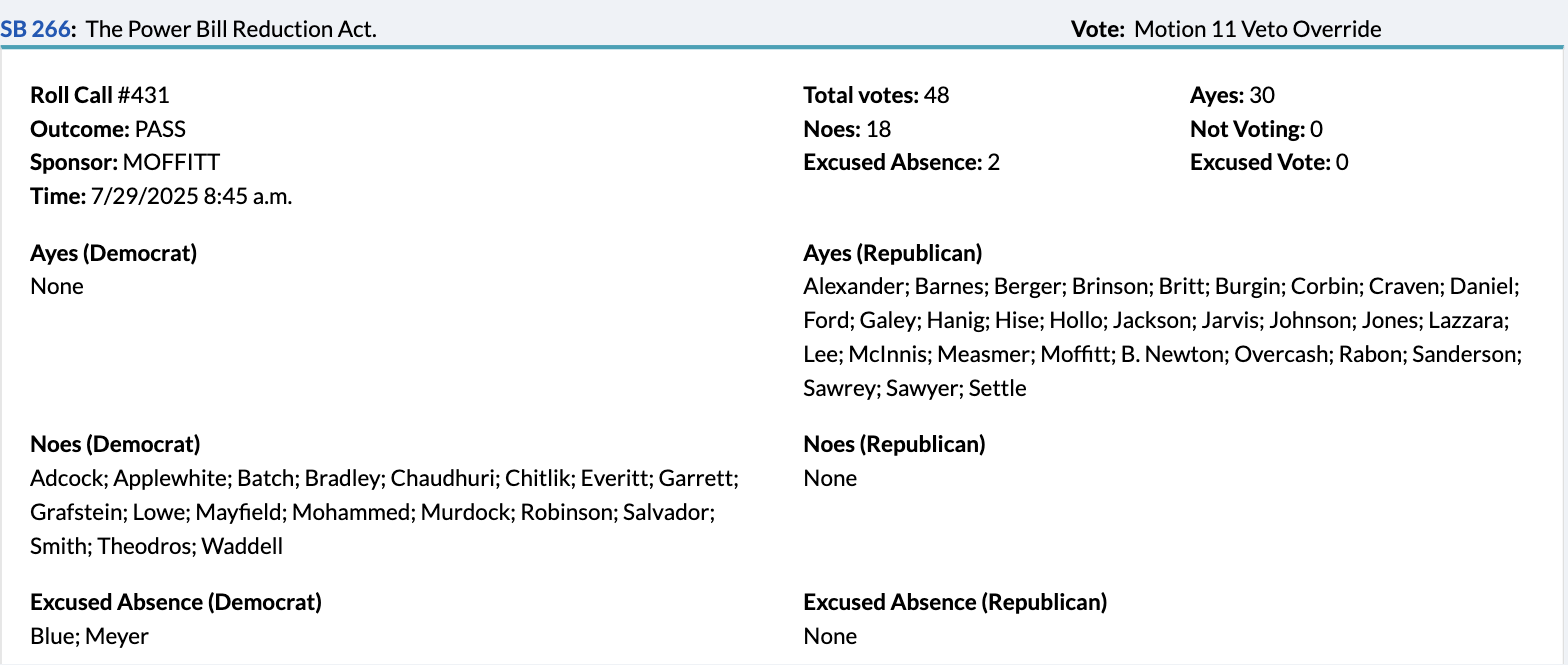
Governor Stein vetoed it and said plainly that it moved costs onto families. The Senate overrode him on July 29, 2025, with every Republican senator voting yes, including the one who represents Stokes and Forsyth, and every Democrat voting no. The House finished it the same day. The roll calls are public, and worth a look.

Receipt · ncleg.gov
The official Senate roll call transcript for Roll Call 431 on SB 266, The Power Bill Reduction Act, showing the veto override passed with 30 Republican ayes, zero Democratic ayes, and 18 Democratic noes on July 29, 2025.
the actual state record. note the line that says "Ayes (Democrat): None"
Senate veto override · Roll Call 431
30 AYES, all Republican18 NOES, all Democrat
House veto override · Roll Call 586
74 AYES (71 R, 3 D)46 NOES, all Democrat

Sources: SB 266 (Session Law 2025-78) · Senate Roll Call 431 · House Roll Call 586 · WUNC's coverage of the NC State cost analysis and the residential fuel-cost shift

About those data centers

Step 3 of the cycle needs a forecast, and the data centers are it. In this system a demand forecast works like a permission slip: it's the document that turns "we want to build" into "we get to build, and you get to pay for it." Duke's estimate of what new large customers will need, mostly data centers, has grown every time the company has updated it, and Duke now says data centers could be a quarter of everything it serves in the Carolinas by 2030. On the strength of that projection, it plans roughly 14 gigawatts of new generation by the end of the decade, and it gets to keep the old plants running for the same reason.

3.9GW
the large-load forecast two years ago
6GW
the forecast by May of last year
8GW
the forecast now, for 2035

Maybe the demand shows up. But notice who carries the bet if it doesn't: under the new law, the construction charges started landing on your bill while the concrete was still wet, and there's no provision for handing that money back. Duke is meanwhile offering special rate terms to attract the data centers themselves, which tells you which customer is being courted, and it isn't the house at the end of a gravel road in Quaker Gap.

There's a separate page on the data-center push if you want to go deeper on that piece.

the forecast doubled in two years

Sources: Canary Media on Duke's data-center forecasts · Duke's 2025 Carolinas Resource Plan · Canary Media on the proposed data-center tariff

Why the old coal plants won't die

Collage illustration of a coal plant smokestack beside a lake at dusk.

If you care about the climate side of this, you've probably wondered why a company would fight to keep 1970s coal plants running while asking the legislature to repeal the state's carbon targets. The answer is less ideological than it looks. It's the same machine as everything else on this page.

Remember the fuel line from Part 1: it passes through at cost, so burning expensive, inefficient coal costs Duke's shareholders nothing... you pay for it, and SB 266 shifted more of that burden onto households at the same time. Meanwhile an old plant is still rate base. Its remaining book value keeps earning the guaranteed return, and every "reliability upgrade" that keeps it limping along is fresh investment earning 9.8 percent. Retiring it early would mean writing chunks of that off, on a schedule Duke didn't choose.

The 2030 carbon checkpoint was that schedule. It would have forced the old plants into retirement whether or not it suited the balance sheet, which is exactly why it had to go. With the checkpoint repealed and federal rules loosening, Duke gets to run coal into the 2040s, collect on the upgrades, and still build everything new for the data centers, with the up-to-23-billion-dollar fuel tab from the repeal landing on ratepayers, where it never touches the profit math. The carbon plan lost an argument about rate base, and the science was never really in the room.

Sources: fuel pass-through per NCUC ratemaking (annual fuel rider dockets) · NC State University analysis of the interim-target repeal (up to $23B) and the ~19% residential fuel-cost shift, via WUNC · WUNC on the coal retirement delays

South Carolina already ran this experiment

The charge-during-construction idea has a track record one state away. South Carolina passed its version in 2007. Customers there paid roughly two billion dollars, across nine rate increases, for two nuclear reactors that were abandoned half-finished in 2017. The utility's CEO went to prison for misleading people about the project, and the legislature repealed the law.

Collage illustration of a half-built cooling tower with coins falling into a hole at its base.
$2B
paid by South Carolina customers during construction
9
separate rate increases along the way
0
watts anyone ever got out of that hole in the ground

Our new law is the same species as theirs. And the next candidate for a project financed this way is already picked out: in January, Duke filed an application with the Nuclear Regulatory Commission for small reactors at the Belews Creek coal plant, on the lake in eastern Stokes County. The plant, the lake, and what Duke has planned out there deserve a full page of their own, and I'm working on it.

Sources: South Carolina Base Load Review Act (2007, repealed 2018) · V.C. Summer Units 2 & 3 abandonment, 2017 · United States v. Kevin Marsh (SCANA), guilty plea, 2021

This part is actually fixable

The setup we have, an investor-owned monopoly earning a guaranteed return on whatever it builds, is a choice, and other places have chosen differently. Hawaii passed a short law in 2018 ordering its utility commission to break the link between utility revenue and construction, so the utility there earns more when the lights stay on and rooftop solar gets connected quickly, and nothing extra for pouring concrete nobody asked for. Colorado makes its biggest utility win an open competition before it builds anything new. Nebraska, which nobody has ever accused of being a commune, has no investor-owned electric utility at all: the whole state runs on public power districts with elected boards, and their rates sit below the national average.

You don't even have to leave the district

Surry-Yadkin EMC, the electric co-op serving parts of Stokes and Forsyth along with three neighboring counties, answers to its 27,000 members instead of shareholders. When it collects more than it needs, the margins go back to members as capital credits. Their power company mails them money. Ours mails Charlotte a dividend.

I want to be straight about the limits, because the places that tried a hostile government takeover of their big utility have mostly lost those fights, and I'm not pitching one. What a state senator can actually push for is duller and more useful: pay the monopoly for performance instead of construction, make it compete for the right to build anything big, and protect the co-op and municipal models that already work here.

capital credits are a real thing... ask around

Sources: Hawaii Act 5 (2018) and the Hawaii PUC's performance-based regulation framework (Docket 2018-0088) · Colorado all-source competitive solicitations · Nebraska public power (all utilities consumer-owned since the 1940s) · Surry-Yadkin EMC

About that 3.7 percent

If you follow this stuff, you might reasonably object that the system just worked. Duke walked in asking for 15 to 18 percent over two years, the Public Staff pushed back on behalf of customers, and the settlement on the table averages about 3.7 percent a year. The pushback was real, and the people who did it deserve the credit.

Think of it like pie

Duke has told Wall Street its profit will grow 5 to 7 percent every year, and that promise is load-bearing... miss it and the stock slides and the bonuses dry up. Duke's profit is a slice of everything it builds, and the settlement trimmed the angle of that slice. The promise didn't budge. So there's really only one move left: bake a bigger pie.

The 103 billion dollar construction plan is the bigger pie. The pie tin is your bill.

The settlement even schedules the 2027 and 2028 increases as payments tied to construction getting done. I'd read the 3.7 as the machine running quietly rather than the machine being fixed.

Sources: NCUC Dockets E-7 Sub 1329 and E-2 Sub 1380 · the partial settlement announced July 17, 2026 (9.8% ROE, multi-year rate plan with construction-contingent increases and a refund rider) · Duke Energy investor guidance

The fix runs through the legislature

The Utilities Commission votes on the settlement this fall, and the commissioners are appointed, so you don't get a say in that room. But every rule the commissioners have to follow got written up the street at the General Assembly, and every fix in Part 7 is legislation. Hawaii's entire reform started as a bill a few pages long, ordering its commission to pay the utility for performance instead of construction. North Carolina could pass the same kind of law tomorrow. What it needs is legislators who'll sponsor it, and the ones who represent us right now voted for the current rulebook instead.

Which means the fight over your power bill is a state legislature race. That happens to be the race I'm running, and if a power bill is what brought you here, this is where it goes.

This page cites its work. Every claim traces to a roll call, a docket, or a published filing, and if you find something wrong, email hello@andycantwin.com and I'll fix it and say so publicly.